The Last Picnic

The Last Picnic (2025)

Scroll (in custom-made box)

Open: 28cm x 178cm (11″ x 70″)

Materials Marker Pens on 250gsm paper, flip top box

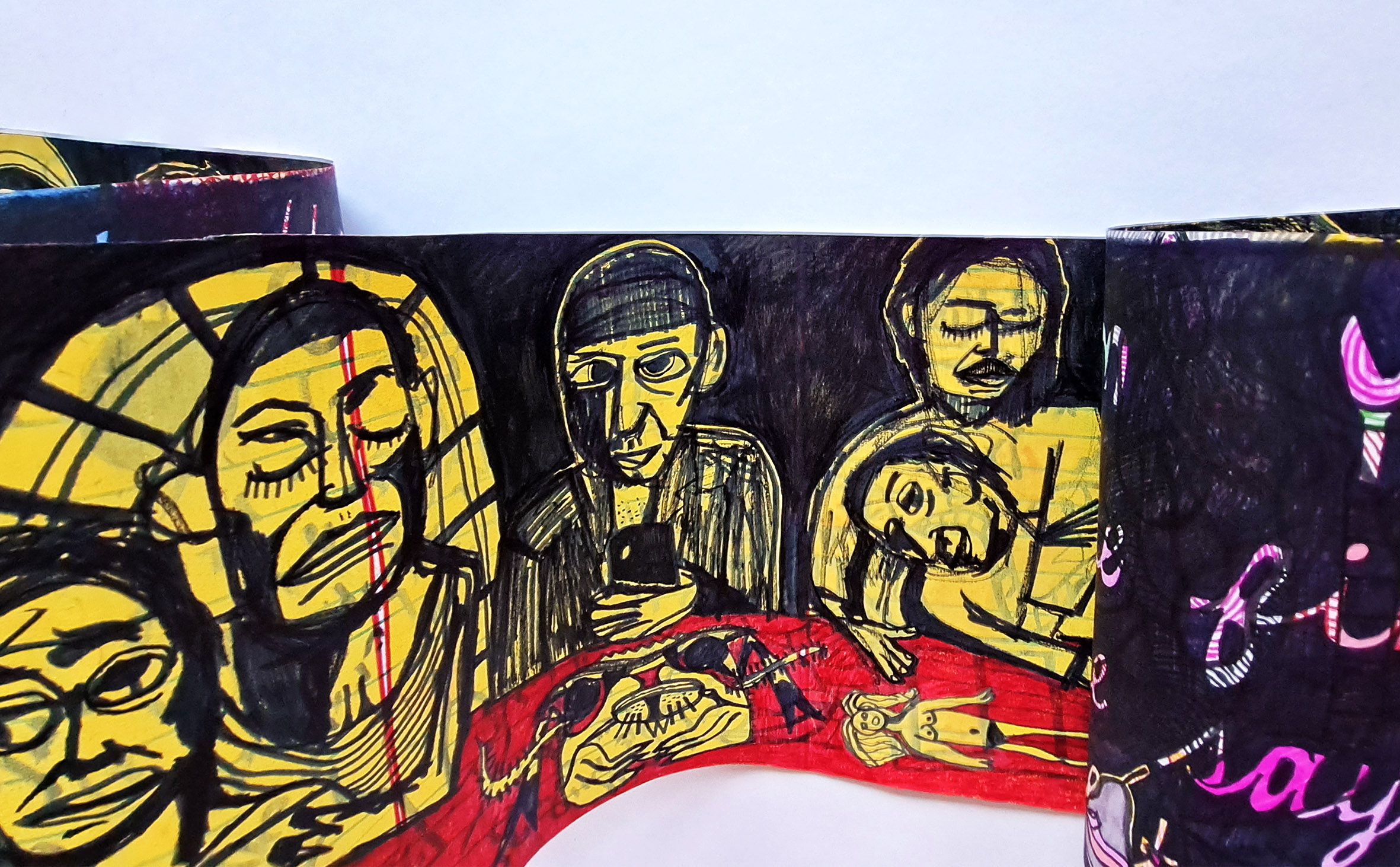
The Last Picnic is a scroll created in response to the ongoing destruction in Gaza and the religious-nationalist fervour in Israel that underpins it. The scroll opens to reveal a single continuous drawing in black marker on yellowed paper (an earlier drawing forgotten): a picnic table in red, surrounded by figures caught in a moment of fractured communion. The composition echoes Da Vinci’s Last Supper, a gathering teetering on the edge of collapse. Some figures stare directly outward, others are lost in phones, in drugs, in grief, rage, or comfort. Relics of violence – an abandoned doll, a drone, a pair of shoes – scatter across the tablecloth.

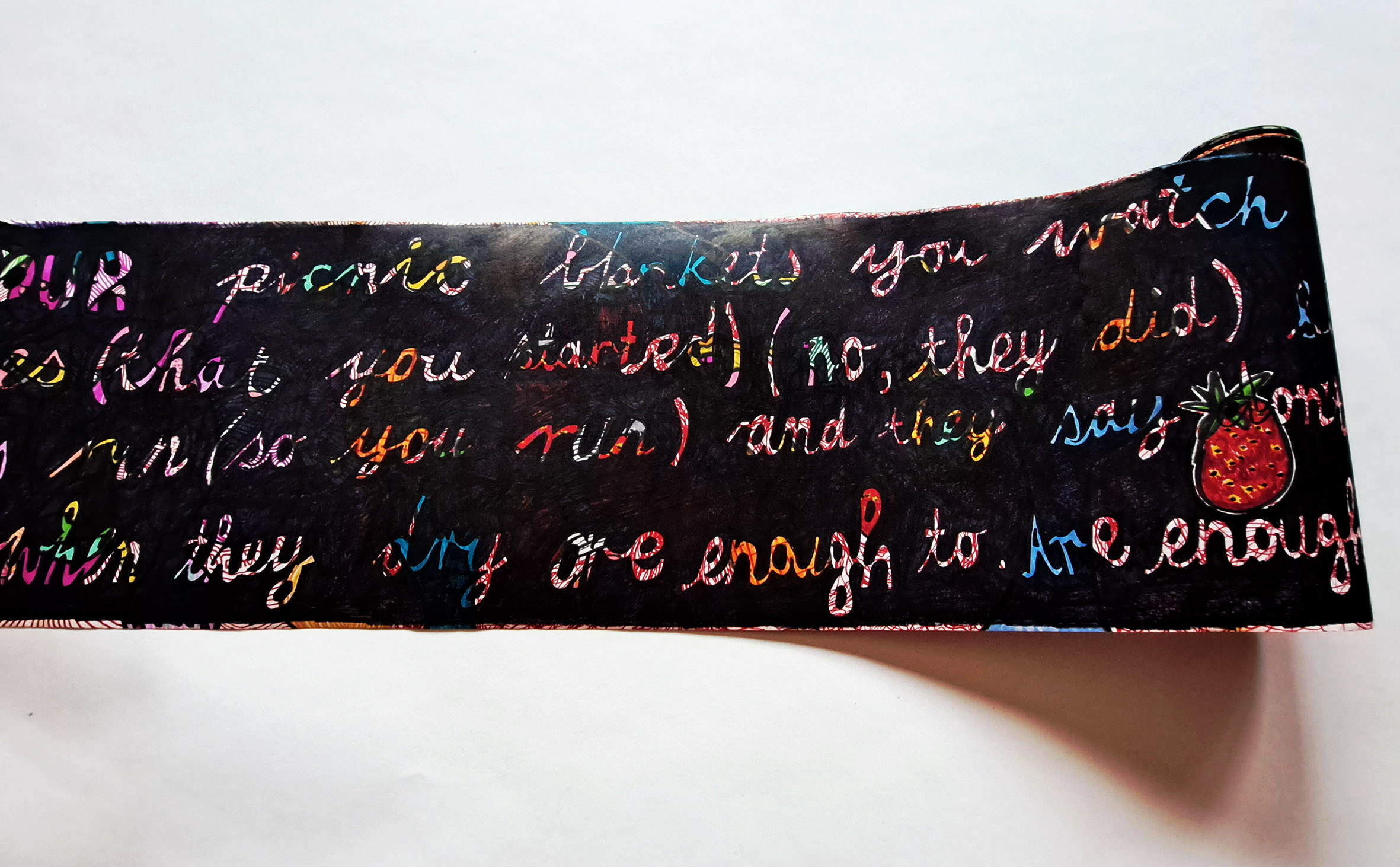
On the reverse of the scroll is a handwritten text, formed in multicoloured cursive over a dark surface: From your picnic blankets you watch the city in flames and the fires (that you started) (no, they did) slowly make their way to you someone says run (so you run) and they say don’t look back (but you look back) and the tears when they dry are enough to. Are enough enough enough.

This text overlays what was once a colourful drawing of a picnic: people kissing, fruit, a shared blanket. That earlier image has been erased, charred over, though faint traces remain. The colour beneath is both ache and hope: a suggestion that no people, no joys, can be fully erased.

The scroll connects to the Torah scrolls and Dead Sea Scrolls of my time in Israel-Palestine, of growing up in a Small Jewish community in South Africa, and to the long tradition of stories that spread out across time and generations. Having lived in Israel for nearly twenty years, served in the Israeli military, and left in the mid-1990s, I’ve watched with sadness and horror as the country has moved ever further to the right. The current onslaught on Gaza feels not only catastrophic but Biblical in tone, waged by a government driven by Messianic beliefs and a literal reading of scripture.

The title refers to a moment on the edge: a final joy before collapse. The last picnic in Gaza before the bombs fell. The last picnic in Israel before the attacks in October 2023. The drawing references images of Israelis gathering on hilltops to watch the bombardment of Gaza, like some grotesque cinematic event. I want The Last Picnic to live in all the complexity of witnessing, betrayal, participation, and denial.

Much of the scroll is in black ink: a deliberate flattening of nuance, a reflection of how the world is increasingly seen in absolutes. But even through the layers of erasure, colour insists on its presence. It is not the optimism of recovery, but a kind of visual resistance: the past refusing to be fully covered over.

My recent artists’ books – scrolls and concertinas – are becoming more compact to hold but larger when unfolded. I want them to be portable and vast, intimate and immersive. The Last Picnic is stored in a custom-made flip-top box, a kind of reliquary, inviting the viewer to peer inside, to participate, to bear witness.

Keep It Simple

Keep It Simple (An Ethic of Maintenance) (2023)

Concertina book

Open: 24.5cm x 176cm (9.6″ x 69.2″), Closed: 24.5cm x 18.7cm (9.6″ x 7.3″)

Materials Colour pencils on 250gsm paper, board covers

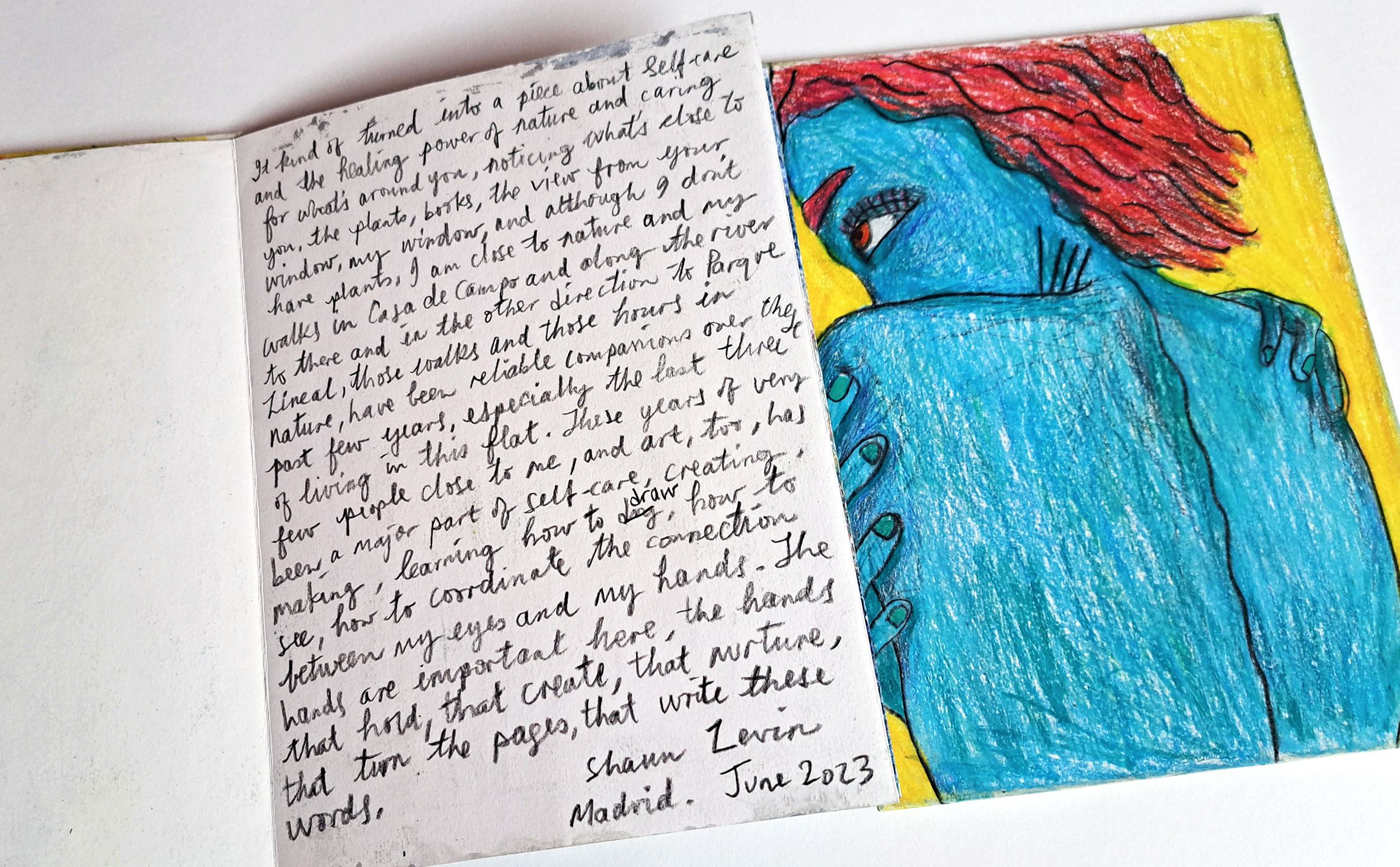
Keep It Simple (An Ethic of Maintenance) is a visual meditation on care as practice. The work offers a quiet resistance to speed, productivity, and spectacle. It documents a period of isolation, during which daily walks through some of the city’s natural expanses became a vital form of connection to the living world.

Rendered in CMYK colored pencils, the artificial hues, particularly the repeated use of Avatar-blue in the figure, introduce a gentle fictionality. The blue body suggests estrangement, a kind of otherness, alien but present in the everyday. Living as an immigrant in Spain, the use of color becomes both a distancing mechanism and a way to make space for new belonging. The stylization allows for a kind of emotional universality, where individual gestures (spraying pot plants, a foot resting on a desk, reading, a table fan) can be anyone’s.

Drawing as a way of figuring out what to look at and how to see is a form of root-taking in a place and a practice. This personal visual language, this rhythm of line and colour, mirrors a broader search for a sense of place. Hands recur: turning, holding, making. Through them, we enact a quiet ethic of maintenance, a daily rehearsal of attention, an aesthetic of survival.

The title draws on Michel Foucault’s concept of the care of the self: the book is a document of this sustained relation to one’s own body, its habits and surroundings. Here, care manifests in drawing, walking, noticing. In repetition and presence.

Text on reverse reads: It turned into a piece about self-care and the healing power of nature and caring for what’s around you. Noticing what’s close to you, the plants, books, the view from your window, my window, and although I don’t have plants, I am close to nature and my walks in Casa de Campo along the river, to there, and in the other direction, to Parque Lineal, those walks and those hours in nature have been reliable companions over the past few years, especially the last three of living in this flat. These years of very few people close to me, and art, too, has been a major part of self-care: creating, making, learning how to draw, how to see, how to coordinate the connection between my eyes and my hands. The hands are important here, the hands that hold, that nurture, that turn the pages, that write these words.

The Ghost of the Artist

The Ghost of the Artist (2023)

Concertina book

Open: 70.5cm x 300cm (27.75″ x 118″), Closed: 70.5cm x 26.5cm (27.75″ x 10.4″)

Materials Colour pencils on blue ink-washed 200gsm paper, board covers

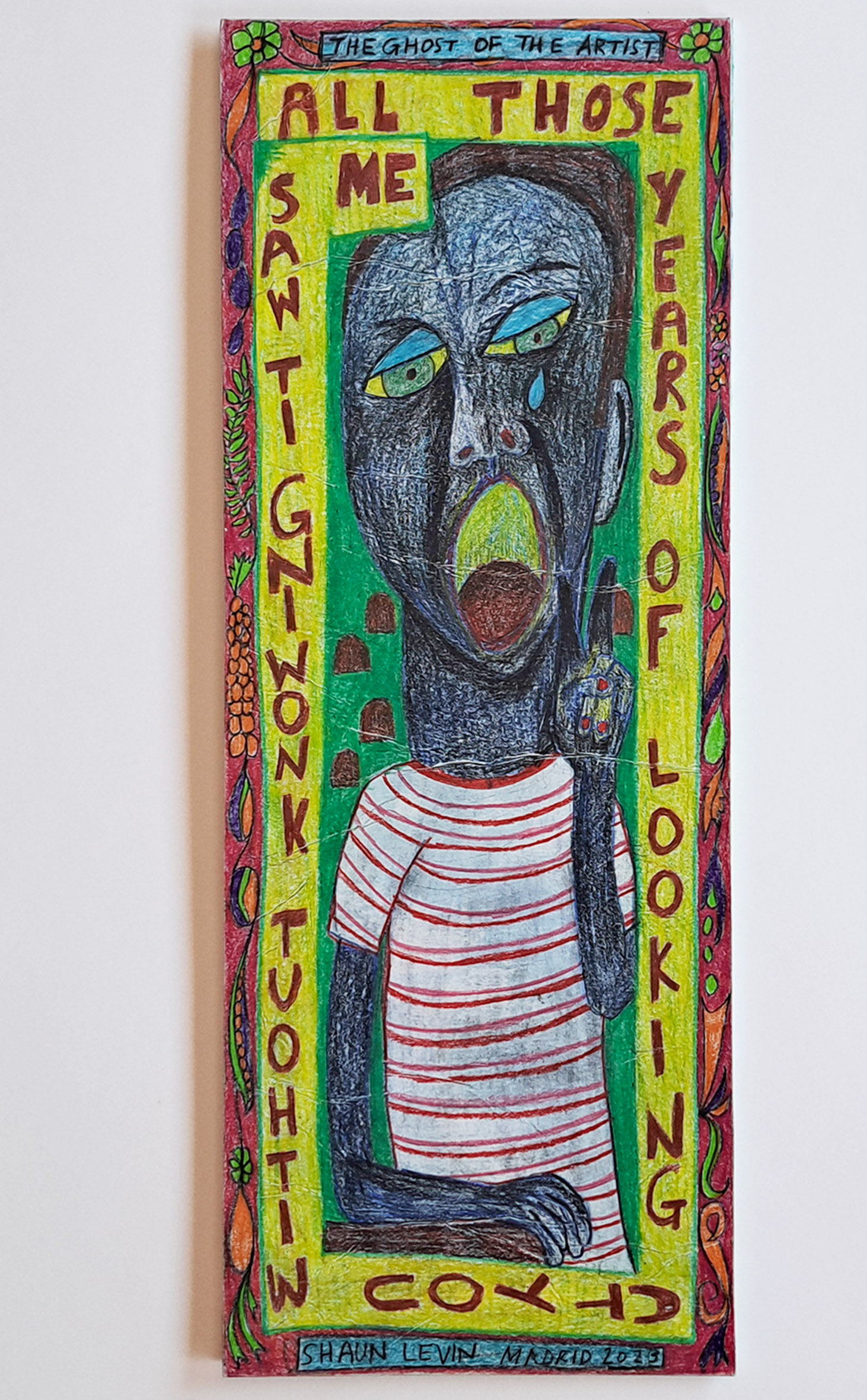
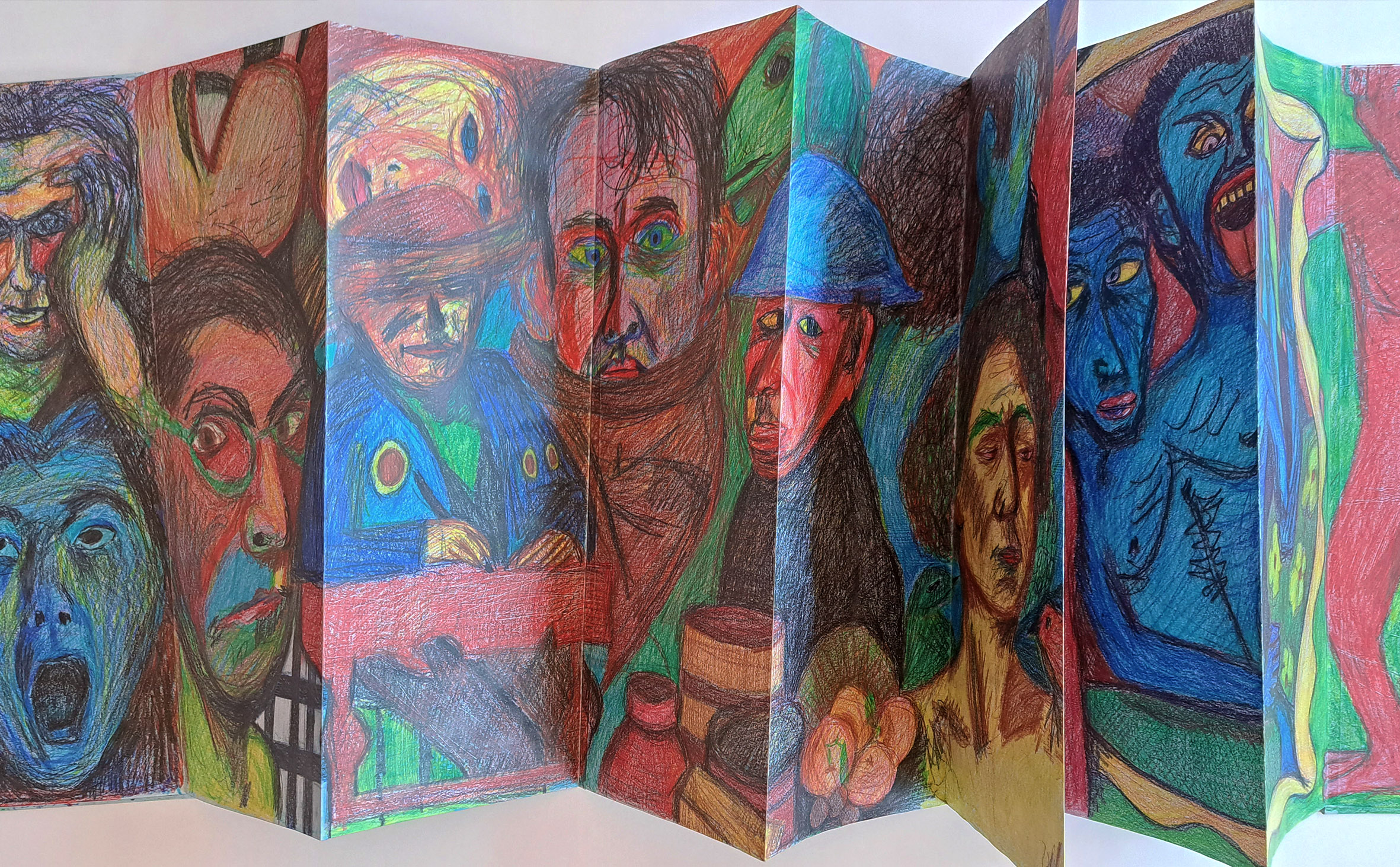
The Ghost of the Artist marks the turning point of claiming visual art as a primary practice after nearly thirty years as a writer. The book unfolds into a vivid procession of faces, some invented, others loosely based on portraits and self-portraits by artists who worked through war, displacement, and political unrest, including Christian Schad, Tetsugorō Yorozu, Philip Guston, William Orpen, and Ilya Mashkov. Each panel contains a single face or partial figure to form a dense, haunted crowd when fully extended.

The work takes its title from the central conceit that an artist-self – imagined, repressed, deferred – has stepped forward. On the reverse side of the book, a hand-written monologue gives voice to this presence. Hovering between humour and heartbreak, theatricality and introspection, the words draw attention to the lifelong negotiation between creative paths taken and those left unexplored.

The Ghost of the Artist grew out of a longstanding engagement with visual art: publishing books about artists, leading writing workshops in museums and galleries, and drawing on the techniques and lives of painters to nourish a literary practice. In this work, that relationship is inverted: image leads and the body speaks through form. The result is a visual self-portrait in fragments, assembled through layers of influence, longing, and personal myth.

Through its performative and fragmented self-portraiture, the work engages with ideas of embodiment and self-fashioning, where identity is fluid, layered, and always in the process of becoming. The visual language draws on the grotesque as an aesthetic strategy for confronting psychological damage and unresolved emotion. As a procession of faces, seen and obscured, the artist (and the viewer) becomes a witness to broader cultural hauntings – those of war, but also the more intimate violences of childhood cruelty and social regulation in places that mistake order for safety, silence for strength.

“For me, this book belongs to a visual language shaped by return, fragmentation, and the slow work of transformation. It marks a return to a visual path I once set aside, and reflects the fragmented nature of identity, memory, and influence that now guides my shift from writing into a more image-led practice.”

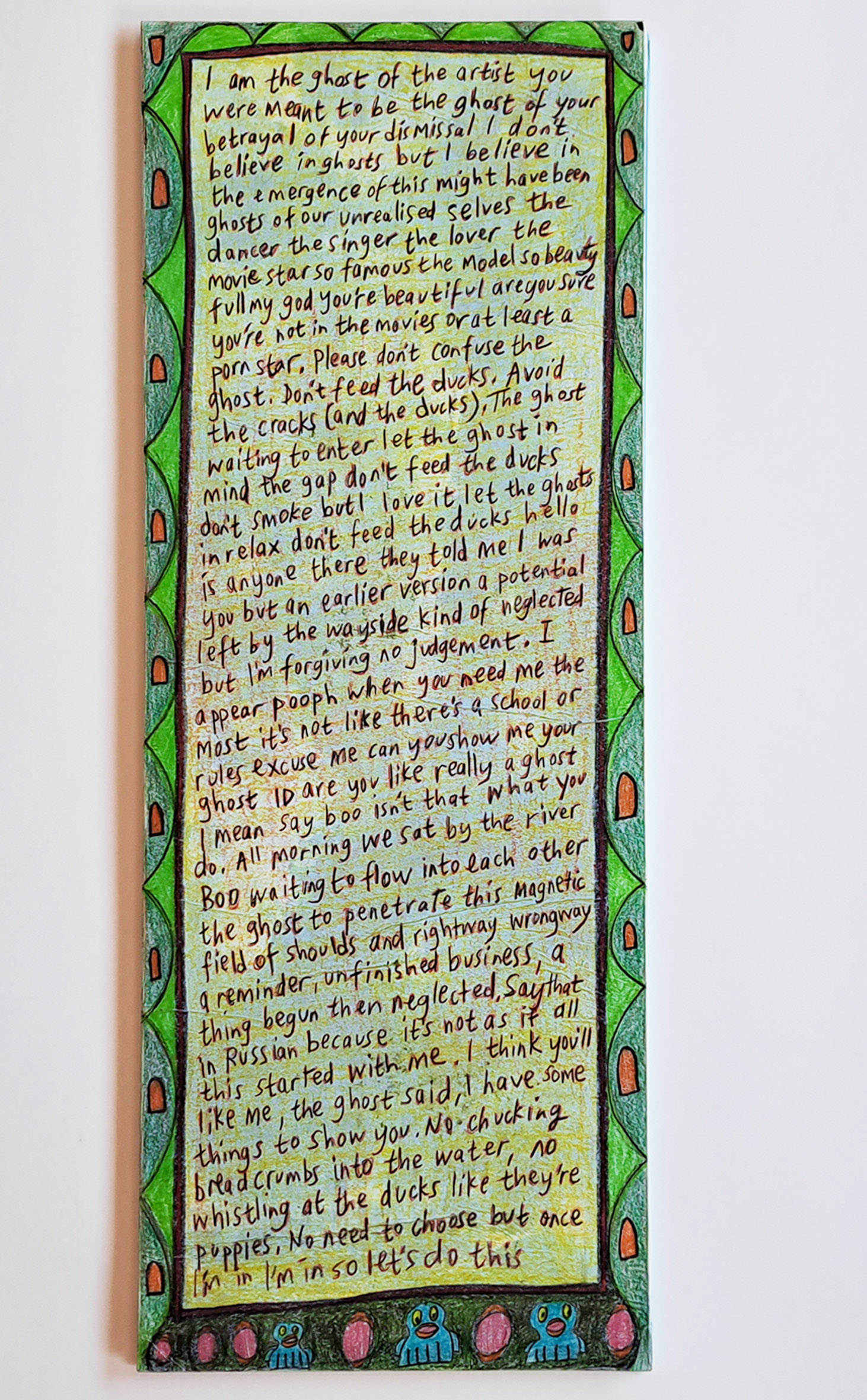
Text reads I am the ghost of the artist you were meant to be the ghost of your betrayal of your dismissal I don’t believe in ghosts but I believe in the emergence of this might have been ghosts of our unrealised selves the dancer the singer the lover the movie star so famous the model so beautiful my god you’re beautiful are you sure you’re not in the movies at least a porn star. Please don’t confuse the ghost. Don’t feed the ducks. Avoid the cracks (and the ducks). The ghost waiting to enter let the ghost in mind the gap don’t feed the ducks don’t smoke but I love it let the ghost in relax don’t feed the ducks hello is anyone there they told me I was you but an earlier version a potential left by the wayside kind of neglected but i’m forgiving no judgement I appear pooph when you need me the most it’s not like there’s a school or rules excuse me can you show me your ghost ID are you like really a ghost I mean say boo isn’t that what you do. All morning we sat by the river, boo, waiting to flow into each other the ghost to penetrate this magnetic field of shoulds and rightway wrongway, a reminder, unfinished business, a thing begun then neglected. Say that in Russian because it’s not as if this all started with me. I think you’ll like me, the ghost said, I have things to show. No chucking breadcrumbs into the water, no whistling at the ducks like they’re puppies. No need to choose but once I’m in I’m in. Let’s do this.

Art Is Great

Art Is Great

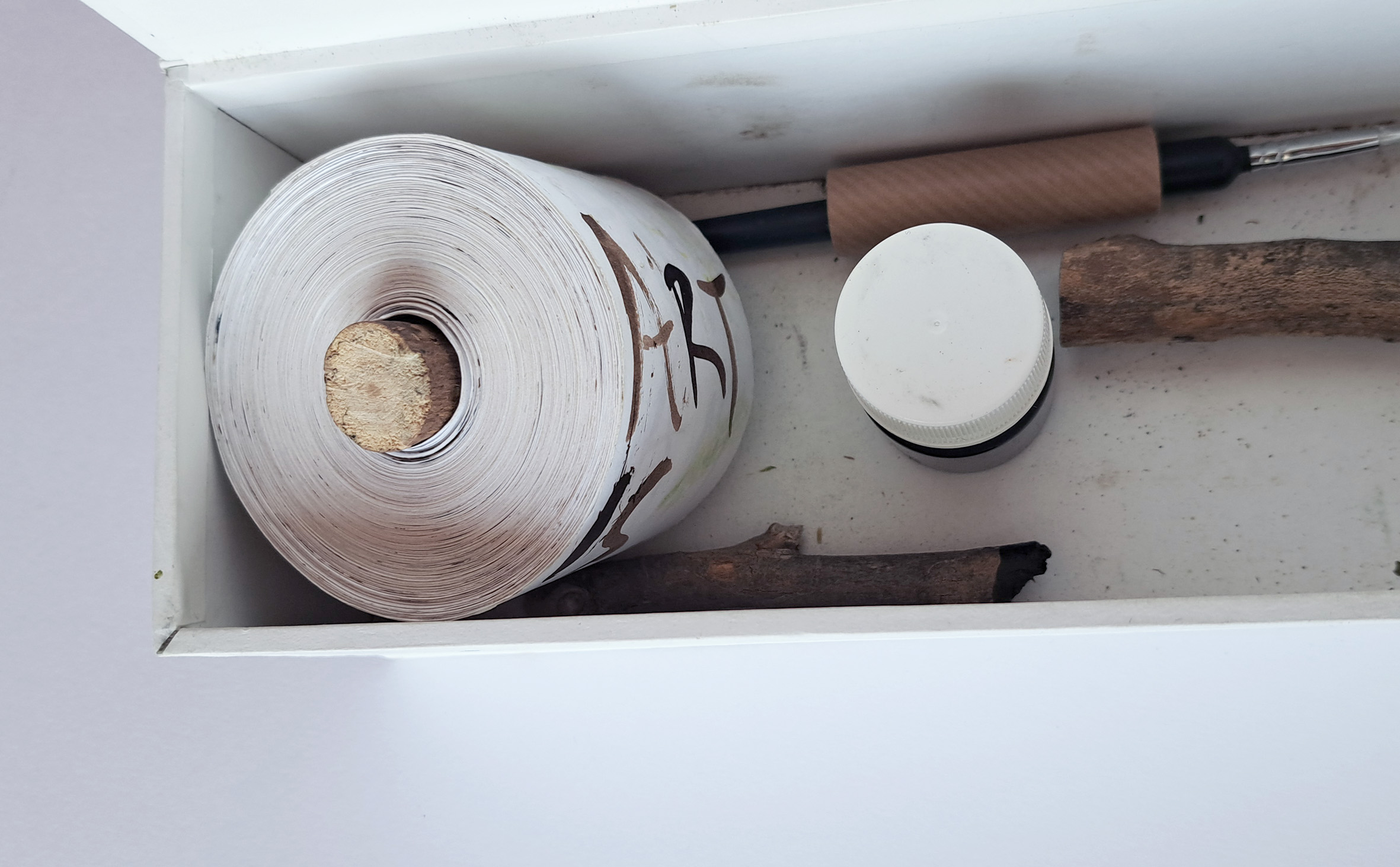
Thermal paper scroll in box Closed (in box): 21.5cm x 9cm x 7.7cm (8.5″ x 3.5″ x 3″), Open: 5.7cm x 6000cm (2.2″ x 2362″)

Materials thermal paper, walnut ink

Art is Great is a 60-meter (196 foot) handwritten scroll on thermal paper, composed in walnut ink over the course of nearly three years, beginning in December 2020, a year into the COVID-19 pandemic. The work began out of solitude: in Madrid, far from from friends and family, creatively uncertain. What emerged over time was a recursive meditation on mark-making, impermanence, and survival.

The repeated phrase “Art Is Great” functions as a structural anchor and a protective refrain: part mantra, part deflection, part prayer. Art as practice and lifeline. Through its repetition, the phrase shifts from ironic to devotional, resigned to euphoric. It becomes the rhythm of staying alive.

This period also marked a personal turning point, as I began transitioning from my identity as Writer (after 25 years of publishing fiction) into making visual art. Art is Great became a stocktaking of language, of memory, of my resources. The use of cash-register thermal paper suggests a ledger of sorts, a reckoning. The act of writing with walnut ink and a watercolor brush begins to dissolve the boundary between writing and drawing, text and mark.

The cadence of my written work was shaped by the rituals of the synagogue, especially the embodied experience of Torah scrolls being read aloud, often seated beside my father in the men’s section. That influence finds its echo here. An intimate liturgy – handwritten, cyclical, and deeply personal – invites the reader-viewer into a form of secular prayer, inscribed during moments of transition, seasonal change, and prolonged isolation.

In its entirety, Art is Great is a record of years lived between worry and wonder. A prayer in a scroll. A thank-you note to Art, and to a father full of enthusiasm about the natural world.

The piece is accompanied by a series of short video fragments documenting the writing process and its surrounding environment, adding another layer of time and atmosphere to the work.

TextArt is great. It’s like the seeds and the flowers all in one, really. Art is great. It’s like everything you need is inside, like seeds. Art is that which I impart. That’s what it is for me. Sharing of the wonder that is the world, which is one thing I inherited from my dad. The world is awesome. All of it, because you have to love it in its entirety. The world is great. Ergo art is great. I think my dad felt that deeply a profound sense of wonder and curiosity and a connectedness to all things and beings. It’s overwhelming to feel so connected. Art is fab. It’s so great. It alleviates the loneliness that comes with that awareness of a connection to and with everything. Today is Saturday and there are groups of people everywhere. Everywhere here. Although it’s suddenly gone. It’s suddenly gone and I feel calmer. And that too is an inheritance from my dad. People are sometimes nicer when they are gone. Art is great. I think I need to take a break. A few days later and I’m here in the park, Casa de Campo. But it’s too cold for art. Or my heart is too cold and too needy for anything particularly creative. And I’m not sure what I’m doing. Sometimes art is an escape, a way to find work for idle hands. Art is the devil’s work. I used to feel blah, blah, blah, whatever. Some moons later or thereabouts we’re at war again, papa. And that makes art very difficult. And here in the park the people laugh like savages and French men jog. Can you jog my memory?” To read the full text, click here.

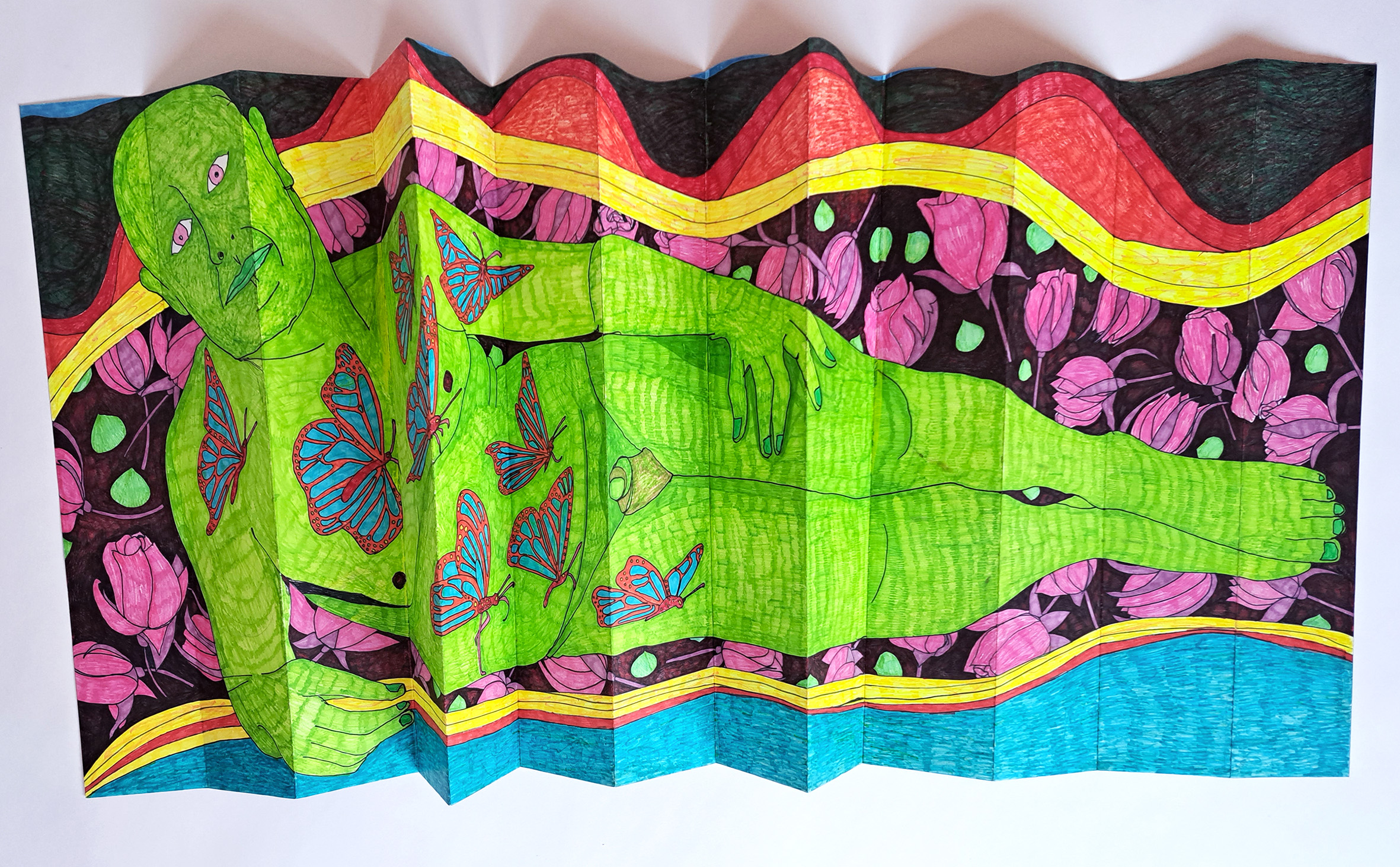
Reclining Self

Reclining Self (or: The Things I Never Told My Therapist, or: All The Body in Disgust and Splendour)

Concertina Book in Slipcase Closed (in slipcase): 85cm x 16cm (33.4″ x 6.3″), Open: 83.5cm x 192cm (32.8″ x 75.5″)

Materials Sharpie marker pens, paper (hot pressed watercolour paper, 300gsm), greyboard

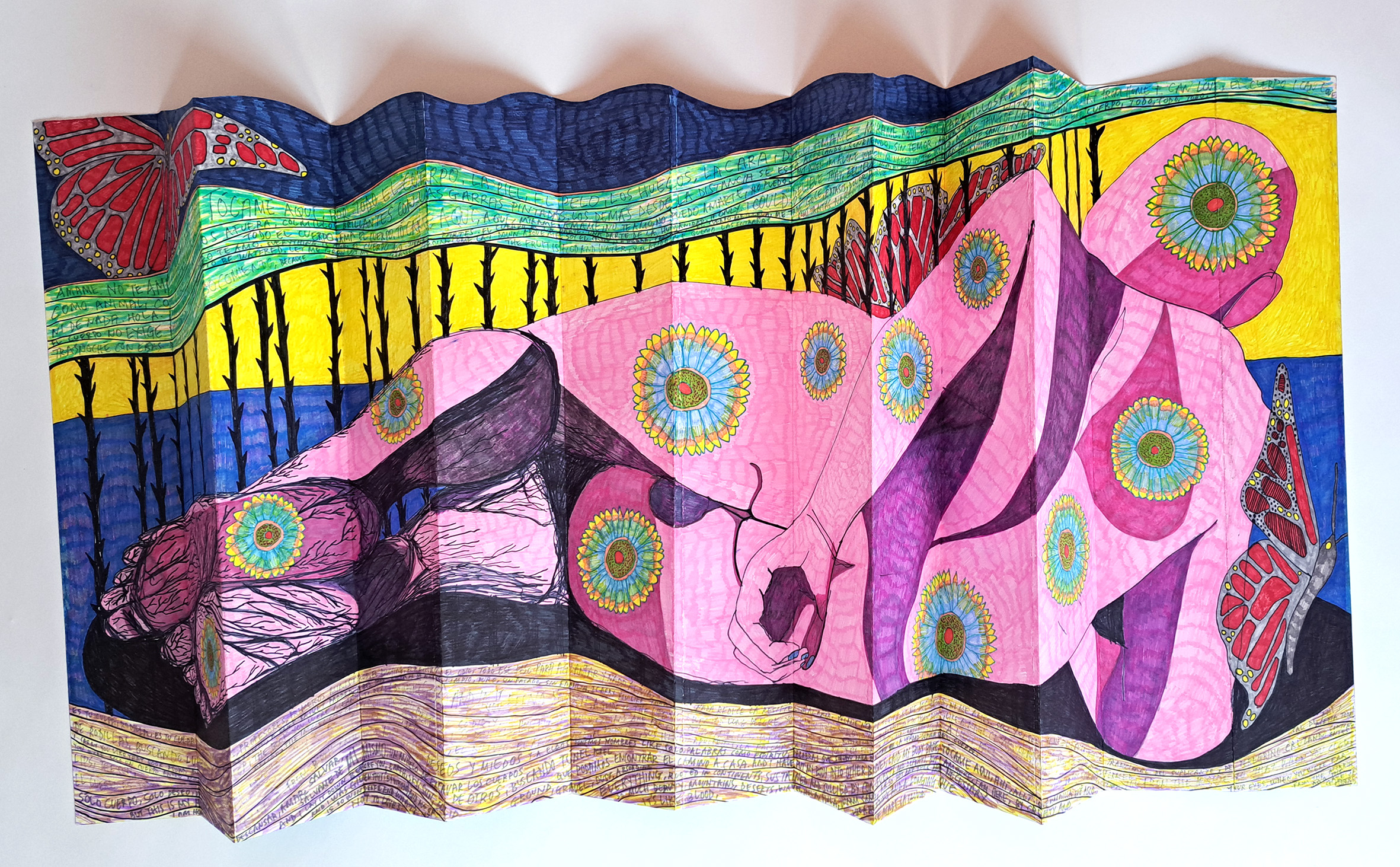
Reclining Self is a portrait and a process: a full-body figure drawn in Sharpie marker pen, rendered front and back, reclining across a concertina structure that unfolds slightly taller than the artist’s own body. The work is in many ways an admission – of body dysmorphia, of joy, of unwanted and welcomed touch. The figure, coloured in green on one side and fuschia pink on the other, balances realism with the surreal, mapping a body in tension between self-image and how it’s perceived by others.

Embedded within the folds is a written text – a confession, a prayer – written in English and Spanish, it drifts between clarity and ambiguity, between asking and refusing: “Ámame, no te amo. Pero ámame… Tócame no me toques… This is my home, and I lay it down before you…” [full text here]

The work borrows its structural language from Sandra Vásquez de la Horra’s intimate foldout works, and gestures toward the reclining nudes of Matisse, Sylvia Sleigh, Modigliani, and others – yet here, the reclining body is not passive. It speaks. It resists. It witnesses itself.

The book itself becomes an extension of the body, not just in scale, but in experience: it opens, folds, stands on its own, retreats. For me, books were the first way to escape the prison of the body, through reading and later through writing them. Reclining Self is both a refuge and a reckoning: a place to lay things down, to unbury the unsaid, to draw the body not as spectacle, but as a space for reflection. Over the months of working on the book, the process became more meditative, an encounter with the self that is tender and layered. The pattern of flowers around the body, drawn from a found bouquet of three dozen dead roses in London’s theatre district, evokes beauty, decay, memory, and the desire to be held.

Reclining Self is not a resolution. It asks the viewer not just to look at the body, but to consider it as a site of becoming, of unfurling.

Text Ámame, no te amo. Pero ámame. No. Tócame, aquí, tócame aquí, por todo el cuerpo, la piel, el pelo, los huecos, la cara, dale, ámame… I carry you like that book discovered by chance in a bookshop, the one you were meant to read (by whom? God?) and in it you found yourself, a guide to the life you wanted, everything in that book, like a magic cloak, magic wand, it transformed you from the inside so that when you closed your eyes, when you were far away from the mirror and the gaze of others, you were solo un cuerpo entre millones, in love with your own desire, how hungry you were you are for everything delicious, melon, both water and piel de sapo, butterflies, skin, lips, the sun, always the sun…To read the full text, click here.