
Reclining Self (or: The Things I Never Told My Therapist, or: All The Body in Disgust and Splendour)
Concertina Book in Slipcase Closed (in slipcase): 85cm x 16cm (33.4″ x 6.3″), Open: 83.5cm x 192cm (32.8″ x 75.5″)
Materials Sharpie marker pens, paper (hot pressed watercolour paper, 300gsm), greyboard


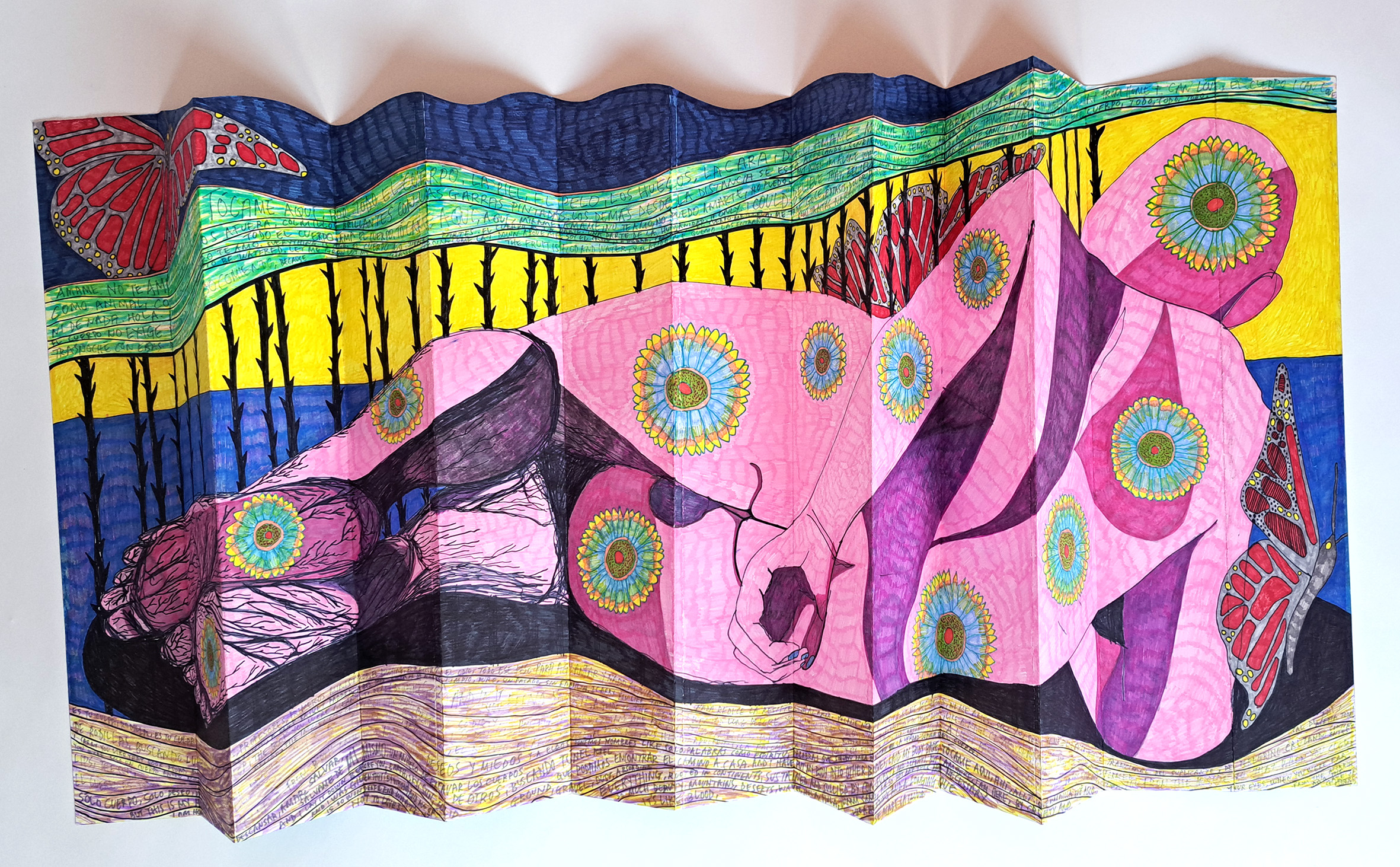
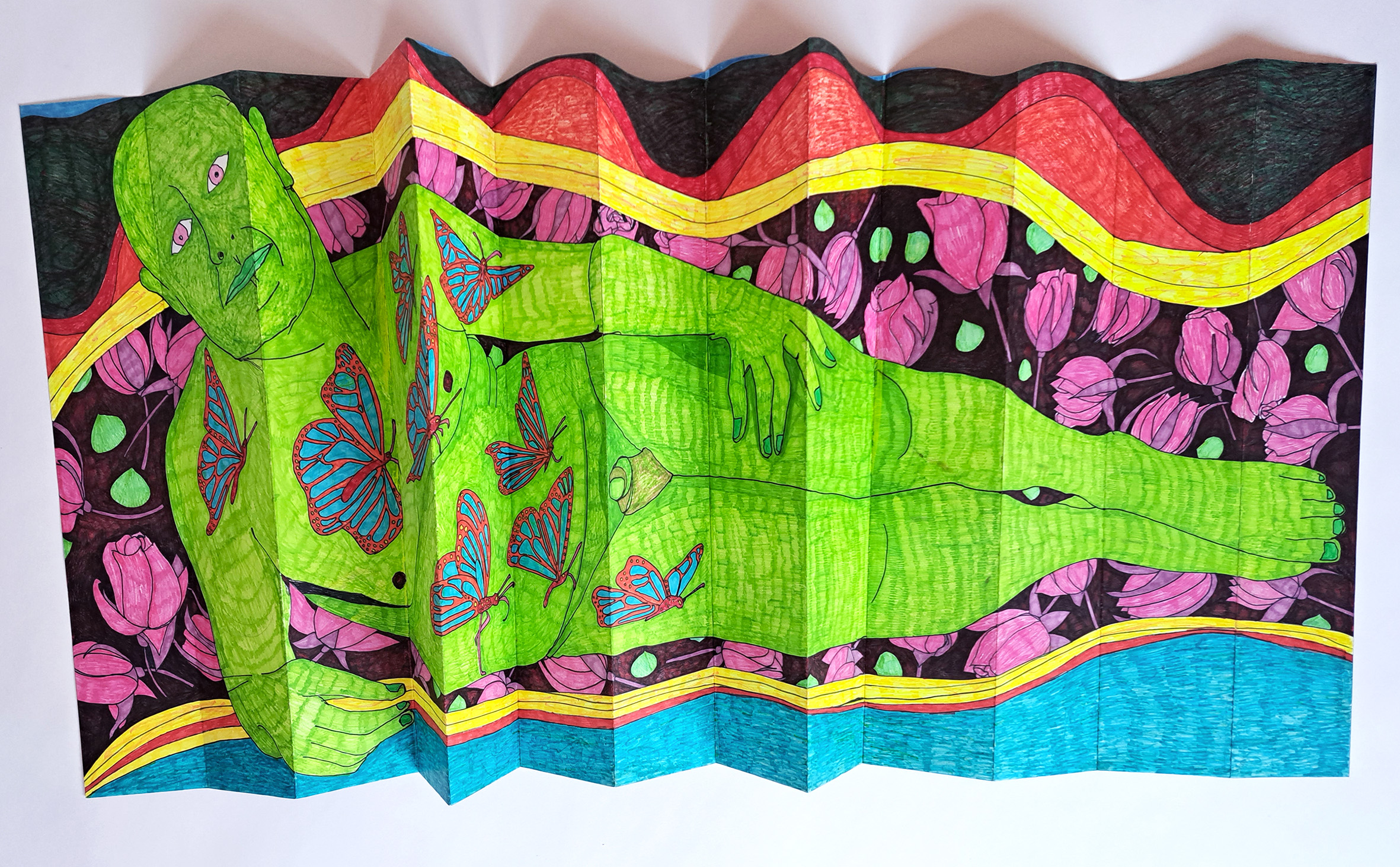
Reclining Self is a portrait and a process: a full-body figure drawn in Sharpie marker pen, rendered front and back, reclining across a concertina structure that unfolds slightly taller than the artist’s own body. The work is in many ways an admission – of body dysmorphia, of joy, of unwanted and welcomed touch. The figure, coloured in green on one side and fuschia pink on the other, balances realism with the surreal, mapping a body in tension between self-image and how it’s perceived by others.
Embedded within the folds is a written text – a confession, a prayer – written in English and Spanish, it drifts between clarity and ambiguity, between asking and refusing: “Ámame, no te amo. Pero ámame… Tócame no me toques… This is my home, and I lay it down before you…” [full text here]
The work borrows its structural language from Sandra Vásquez de la Horra’s intimate foldout works, and gestures toward the reclining nudes of Matisse, Sylvia Sleigh, Modigliani, and others – yet here, the reclining body is not passive. It speaks. It resists. It witnesses itself.
The book itself becomes an extension of the body, not just in scale, but in experience: it opens, folds, stands on its own, retreats. Long before the body can be claimed as home, the book in its traditional codex form often offers a provisional sanctuary, and as a terrain, it maps possibilities beyond the limits of flesh. Reclining Self acknowledges this history of books – both reading them and writing them – as refuge, escape, and a space for transformation.
Over the months of working on the book, the process became more meditative, an encounter with the self that is tender and layered. The pattern of flowers around the body is drawn from a found bouquet of three dozen dead roses in London’s theatre district, evoking beauty, decay, memory, and the desire to be held. The thorns offer a form of protection: not just defense, but a refusal to give oneself away too easily. Butterflies appear as emblems of transformation, each stage – larva, chrysalis, wing – so radically distinct it’s hard to believe they belong to the same life.
Their presence mirrors the making of the book itself: what begins as blank paper slowly accumulates image, language, and gesture until it becomes a kind of performance: theatrical, intimate, loud, irreversible. Reclining Self speaks not only of the body as a site of change, but of the artists’ book as a space where transformation can be held, panel by panel, unfolded, and witnessed.
Text Ámame, no te amo. Pero ámame. No. Tócame, aquí, tócame aquí, por todo el cuerpo, la piel, el pelo, los huecos, la cara, dale, ámame… I carry you like that book discovered by chance in a bookshop, the one you were meant to read (by whom? God?) and in it you found yourself, a guide to the life you wanted, everything in that book, like a magic cloak, magic wand, it transformed you from the inside so that when you closed your eyes, when you were far away from the mirror and the gaze of others, you were solo un cuerpo entre millones, in love with your own desire, how hungry you were you are for everything delicious, melon, both water and piel de sapo, butterflies, skin, lips, the sun, always the sun…To read the full text, click here.


 Shaun Levin
You must be logged in to post a comment.