
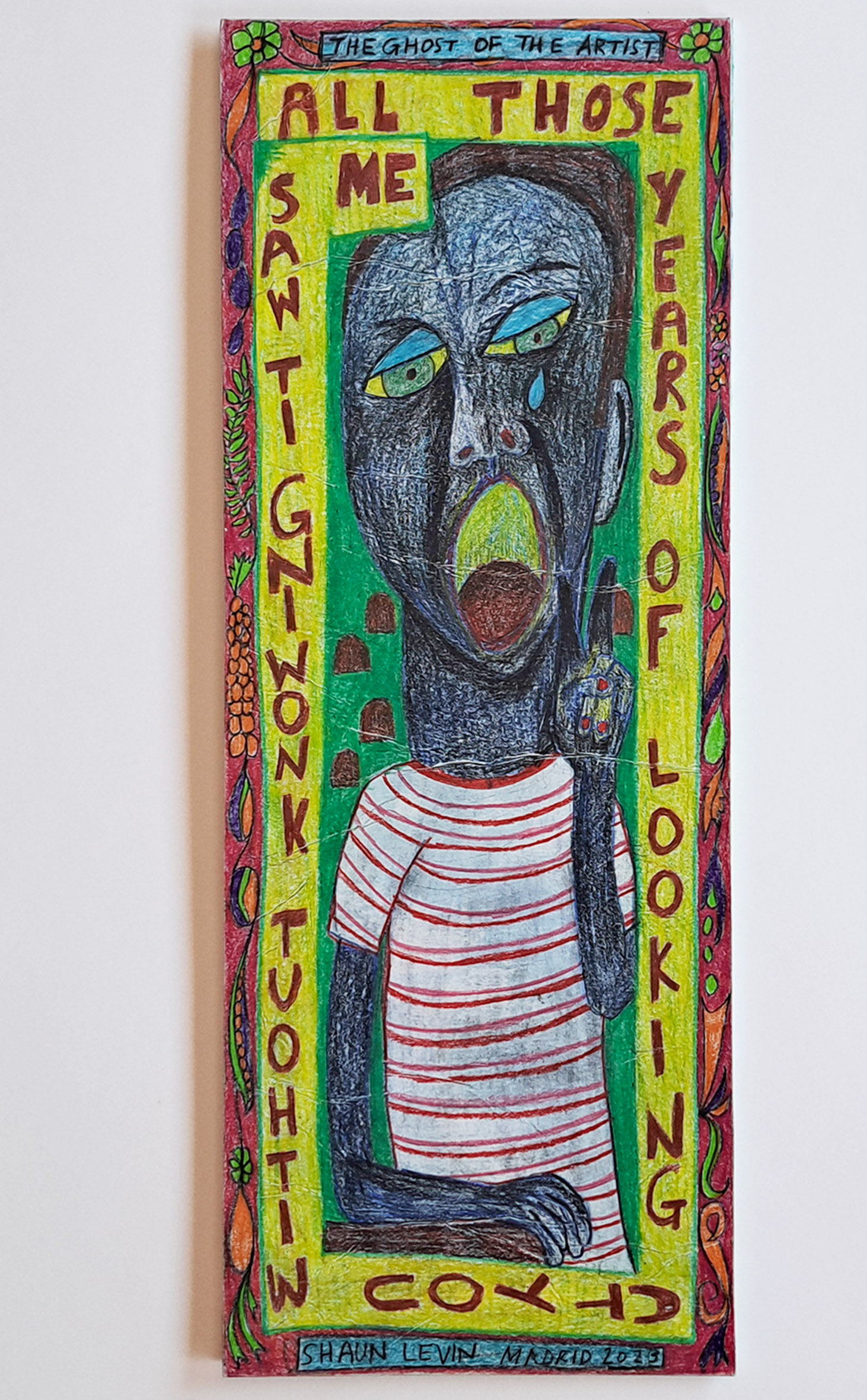
The Ghost of the Artist (2023)

Concertina book
Open: 70.5cm x 300cm (27.75″ x 118″), Closed: 70.5cm x 26.5cm (27.75″ x 10.4″)
Materials Colour pencils on blue ink-washed 200gsm paper, board covers
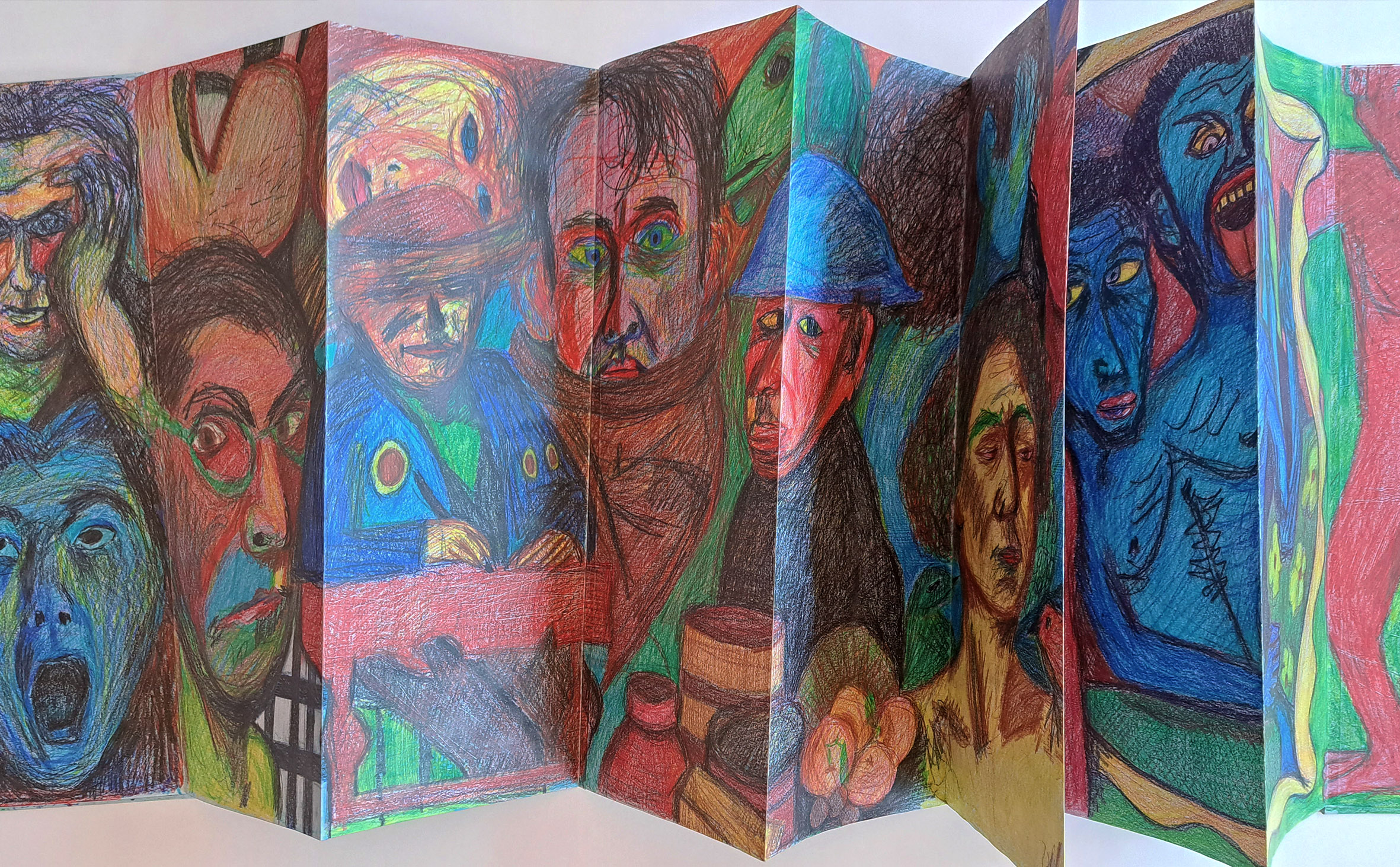
The Ghost of the Artist marks the turning point of claiming visual art as a primary practice after nearly thirty years as a writer. The book unfolds into a vivid procession of faces, some invented, others loosely based on portraits and self-portraits by artists who worked through war, displacement, and political unrest, including Christian Schad, Tetsugorō Yorozu, Philip Guston, William Orpen, and Ilya Mashkov. Each panel contains a single face or partial figure to form a dense, haunted crowd when fully extended.
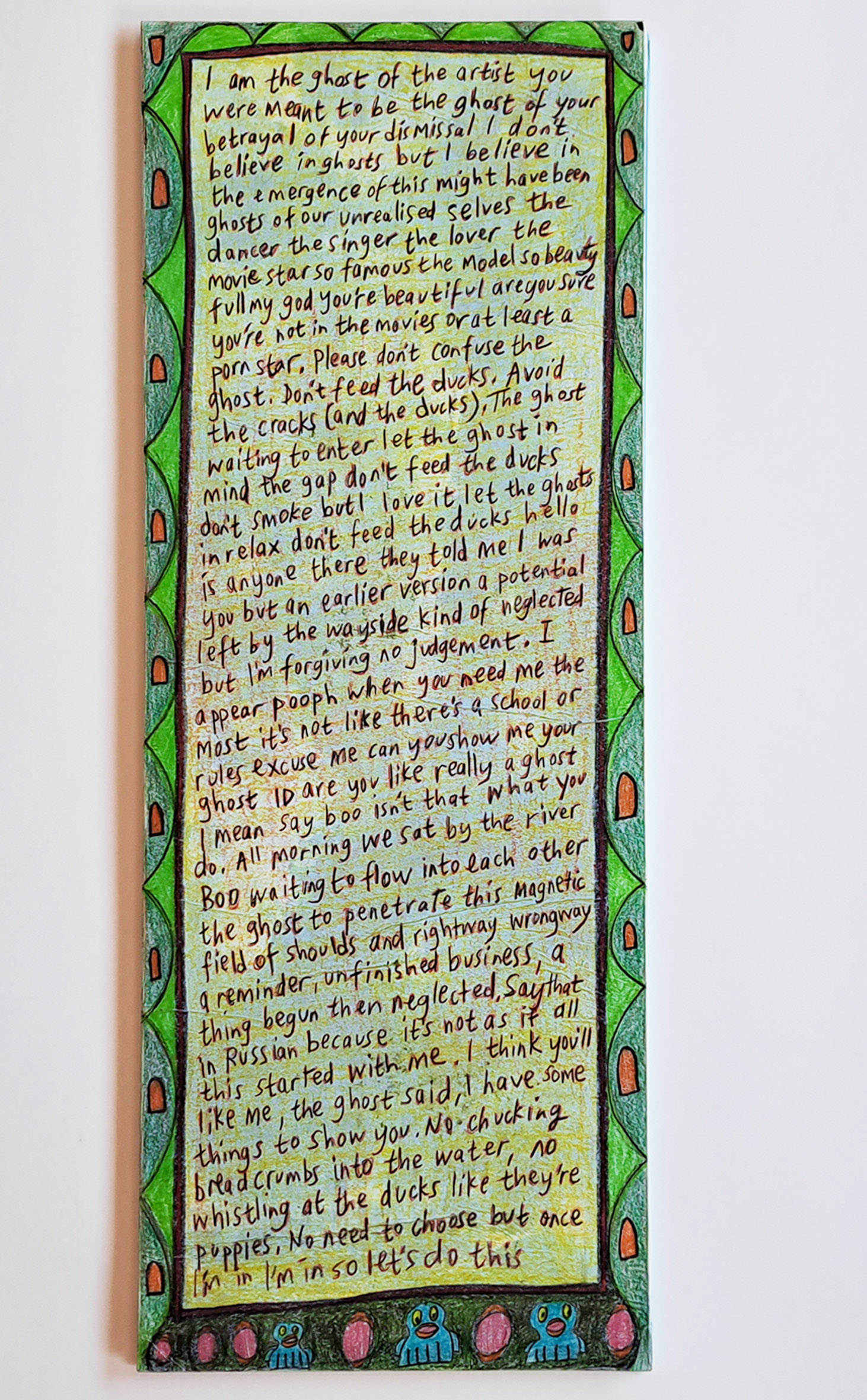
The work takes its title from the central conceit that an artist-self – imagined, repressed, deferred – has stepped forward. On the reverse side of the book, a hand-written monologue gives voice to this presence. Hovering between humour and heartbreak, theatricality and introspection, the words draw attention to the lifelong negotiation between creative paths taken and those left unexplored.
The Ghost of the Artist grew out of a longstanding engagement with visual art: publishing books about artists, leading writing workshops in museums and galleries, and drawing on the techniques and lives of painters to nourish a literary practice. In this work, that relationship is inverted: image leads and the body speaks through form. The result is a visual self-portrait in fragments, assembled through layers of influence, longing, and personal myth.
Through its performative and fragmented self-portraiture, the work engages with ideas of embodiment and self-fashioning, where identity is fluid, layered, and always in the process of becoming. The visual language draws on the grotesque as an aesthetic strategy for confronting psychological damage and unresolved emotion. As a procession of faces, seen and obscured, the artist (and the viewer) becomes a witness to broader cultural hauntings – those of war, but also the more intimate violences of childhood cruelty and social regulation in places that mistake order for safety, silence for strength.
“For me, this book belongs to a visual language shaped by return, fragmentation, and the slow work of transformation. It marks a return to a visual path I once set aside, and reflects the fragmented nature of identity, memory, and influence that now guides my shift from writing into a more image-led practice.”
Text reads I am the ghost of the artist you were meant to be the ghost of your betrayal of your dismissal I don’t believe in ghosts but I believe in the emergence of this might have been ghosts of our unrealised selves the dancer the singer the lover the movie star so famous the model so beautiful my god you’re beautiful are you sure you’re not in the movies at least a porn star. Please don’t confuse the ghost. Don’t feed the ducks. Avoid the cracks (and the ducks). The ghost waiting to enter let the ghost in mind the gap don’t feed the ducks don’t smoke but I love it let the ghost in relax don’t feed the ducks hello is anyone there they told me I was you but an earlier version a potential left by the wayside kind of neglected but i’m forgiving no judgement I appear pooph when you need me the most it’s not like there’s a school or rules excuse me can you show me your ghost ID are you like really a ghost I mean say boo isn’t that what you do. All morning we sat by the river, boo, waiting to flow into each other the ghost to penetrate this magnetic field of shoulds and rightway wrongway, a reminder, unfinished business, a thing begun then neglected. Say that in Russian because it’s not as if this all started with me. I think you’ll like me, the ghost said, I have things to show. No chucking breadcrumbs into the water, no whistling at the ducks like they’re puppies. No need to choose but once I’m in I’m in. Let’s do this.


 Shaun Levin
You must be logged in to post a comment.